
How a quiet studio turned its website into a steady source of real project inquiries
Let’s start with something simple.
We worked with an interior design studio that actually did good work. Strong portfolio, clean execution, happy clients. But online? It didn’t show.
If you landed on their site, you saw images. A few short lines. Maybe a contact form at the bottom.
That was it.
And the problem wasn’t visibility alone.
The real issue was this: nothing on the site helped you decide.
In interior design, that’s everything.
People don’t “browse” designers, they evaluate them
This is where most SEO services approaches fail in this niche.
Interior design is not a casual purchase. It’s not like buying a product.
You’re inviting someone into your personal or commercial space.
So when a user lands on your site, they’re not just reading.
They’re asking themselves:
Does this team understand what I want?
Can I trust them with my space?
Do they work at my level?
If the site doesn’t answer that quickly, they leave.
That’s where we focused first.
SEO plans for interior design companies
Whether you run a boutique design studio, a growing interior design company, or a larger firm handling residential and commercial projects, these plans are built to improve search visibility, strengthen brand trust, and bring in better project inquiries.
Basic SEO
A strong starting point for interior design businesses that need better visibility, cleaner foundations, and a more polished online presence.
- Technical SEO review and core fixes for crawlability, indexing, and on-site performance
- Keyword research for interior design services, studio searches, and local intent terms
- On-page optimization for service pages and high-value landing pages
- Up to 6,000 words of monthly content production
- Meta titles, descriptions, headings, and internal linking improvements
- Google Search Console monitoring, indexing checks, and visibility tracking
- Monthly reporting with clear actions, priorities, and next-step planning
Growth SEO
For interior design companies that want broader reach, stronger brand positioning, and more qualified project inquiries from search.
- Everything included in the Basic plan, with a wider and more growth-focused monthly scope
- Up to 12,000 words of monthly content production
- Advanced keyword mapping across services, locations, and design-related searches
- Broader on-page optimization across multiple service pages and landing pages
- Competitor analysis within the interior design and fit-out market
- Stronger internal linking and site structure planning for better discoverability
- Conversion-focused improvements to increase inquiries and project discussions
- Priority support with a faster and more aggressive growth roadmap
Enterprise SEO
A premium custom SEO plan for larger interior design companies, multi-service firms, and highly competitive markets.
- Fully custom SEO strategy based on your services, project types, and competition level
- Tailored content production based on the real scale of required monthly output
- Advanced roadmap for service expansion, location targeting, and long-term brand growth
- Deep technical SEO collaboration for larger and more complex websites
- Conversion optimization focused on increasing calls, inquiries, and project leads
- Authority building to strengthen your design brand and market trust
- Deliverables built around what your business actually needs, not a fixed package cap
We stopped treating the website like a portfolio
At the beginning, the site was just a gallery.
Nice visuals, but no context.
So we changed the way projects were presented.
Instead of just showing images, we added real explanations:
What kind of space it was
What the client needed
What decisions shaped the outcome
For example, instead of “Modern Living Room Design,” we explained:
This was a compact apartment with limited natural light, so the design focused on opening up the space visually and using lighter materials.
That one shift made a big difference.
Now the work felt intentional, not just aesthetic.
Service pages became specific, not generic
Originally, everything was under one broad label:
“Interior Design Services”
That doesn’t help anyone.
We broke it down into real categories:
Villa design
Apartment interiors
Commercial spaces
Renovation and redesign
Each one had its own page.
And more importantly, each page spoke to a different type of client.
Not just what the service is
But who it’s for, and when it makes sense
That made the content feel more relevant immediately.
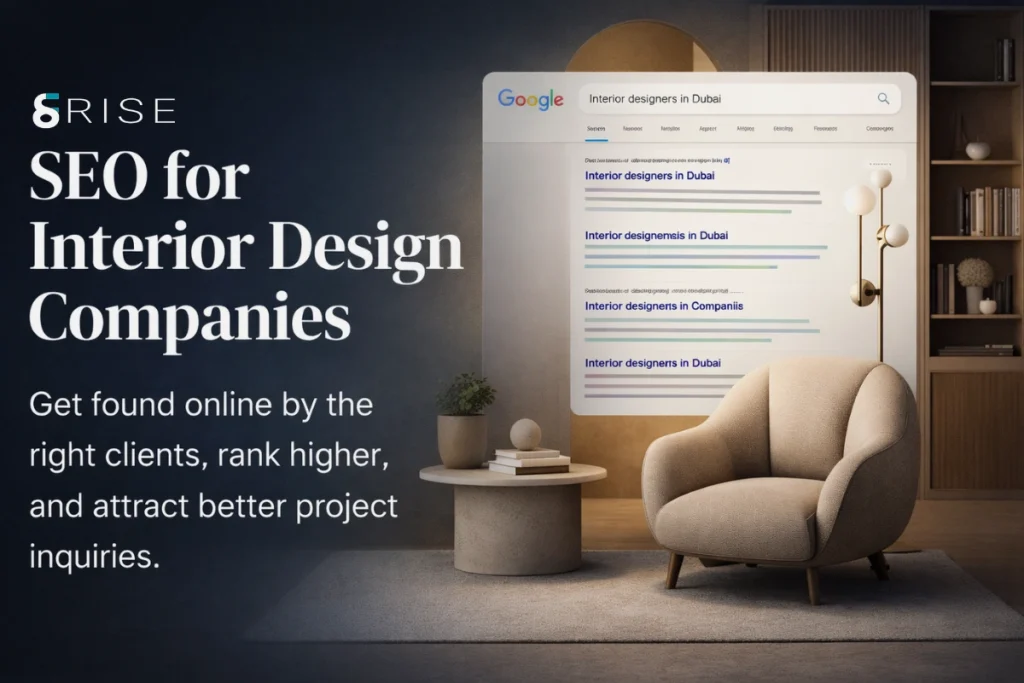
Interior design SEO needs more than rankings
In this niche, people do not just look for a service. They look for taste, clarity, confidence, and proof that the studio understands the kind of space they want to create. That is why the page has to do more than bring traffic.
What separates a strong design SEO page from an average one
A lot of interior design pages look attractive, but still fail to convert. The difference is usually not style alone. It is the way the content helps the visitor decide whether this studio feels right for their space, budget, and expectations.
Looks nice, says very little
Generic visuals, broad service text, and portfolio images with no context usually make the brand feel flat. People scroll, but they do not move closer to contacting you.
Feels clear, specific, and credible
Better SEO pages explain what you do, who you work with, what kind of spaces you handle, and why your work fits the kind of client searching for you.
Only talks about inspiration
Trend articles and broad design talk can bring attention, but they do not always help someone choose your studio over another one.
Helps people make a decision
Good content speaks to real project types, real spaces, and real decision points. That is what makes the page more persuasive and more useful.
Better service positioning
Separate your core services clearly so residential, commercial, renovation, and styling searches do not all land on the same vague page.
More trust before contact
Users often decide very quickly whether a design brand feels premium, safe, and experienced enough to trust with their project.
Higher-quality inquiries
When the page is clearer and better targeted, the people reaching out usually have a stronger understanding of your style and are closer to making a real move.
Content moved from “ideas” to “decisions”
A lot of design content stays at the surface level.
Trends, inspiration, general tips.
We went deeper.
We built content around real decision points:
Where to spend if your budget is limited
What actually changes the feel of a small space
What separates average interiors from high-end ones
Instead of just informing, the content started guiding.
And that changed how people interacted with the site.
A small shift in CTAs changed the outcome
Before, the call to action was basic:
“Contact us”
It didn’t say anything.
We replaced it with something more direct and natural:
“Send us your space and we’ll suggest a direction”
“Let’s review your project idea”
This made the interaction feel easier and more specific.
And users responded to that.
Local SEO was handled with more depth
Location matters a lot in this space.
So instead of one general page, we created targeted location pages:
Interior design in Dubai Marina
Interior design in Downtown
Interior design in JVC
But here’s the key:
We didn’t duplicate content.
Each page reflected what actually happens in that area.
Types of properties
Typical budgets
Common design preferences
That made each page feel real, not templated.
From being seen to being chosen
Interior design SEO is not only about getting found. It is about shaping the moment when a visitor moves from curiosity to confidence. A strong page should guide that shift clearly, instead of leaving the user with a nice impression but no reason to reach out.
Get the right kind of search visibility
The first step is not just ranking for broad terms. The page should target searches tied to real services, real project types, and the kind of clients the studio actually wants to attract. That makes the traffic more relevant from the beginning.
Make the brand feel more considered
In interior design, presentation changes perception fast. The structure, language, and clarity of the page affect whether the studio feels generic or whether it feels like a team that understands space, detail, and client expectations.
Turn attention into project discussions
Once the user sees the right service, understands the value, and trusts the tone of the brand, the page becomes much better at pushing the next step. That usually means better quality inquiries, not just more clicks.
What this page should communicate
A strong interior design landing page should feel sharper than a general service page. It has to communicate fit, confidence, taste, and professional clarity without sounding vague or overly decorative.
- Clear separation between residential, commercial, styling, renovation, and fit-out related intent
- Language that feels refined and useful instead of broad, empty, or trend-heavy
- A structure that helps the user understand what kind of projects the studio is actually suited for
- Better alignment between what the user is searching and what the page promises
Link building stayed controlled and natural
We avoided aggressive link strategies.
Instead, we focused on:
Relevant directory listings
Mentions in lifestyle and design-related sites
Gradual brand visibility
For a newer brand, this approach works better.
It builds presence without looking artificial.
Design itself played a role in SEO performance
Not in a technical way, but in behavior.
We improved small things:
Spacing between sections
Readability of text
Flow between projects and services
Nothing dramatic.
But users stayed longer, explored more, and interacted more.
That matters.
What changed over time
There was no sudden jump.
But the direction was clear.
Search visibility improved
Organic traffic increased
And most importantly, inquiries became more qualified
People who reached out already had a sense of what they wanted.
That’s the difference.
The core idea
SEO for interior design companies is not just about ranking pages.
It’s about helping the user feel confident before they even reach out.
If the site doesn’t do that, traffic doesn’t convert.
If it does, everything else becomes easier.
If you reduce it to one point
Your content should help someone decide, not just browse
Once that happens,
the call, the message, the inquiry, they come naturally.
Read More: SEO for Construction Companies