
Starter site
“I just need a website”
What you usually get
- Theme + page builder layout
- Basic pages + contact form
- Minimal custom sections
- Limited SEO structure
Best for:
simple presence

If you’ve ever requested website design quotes in Dubai, you’ve probably felt that initial confusion that almost everyone experiences. One agency confidently says AED 3,000. Another sends a proposal for AED 12,000. A third presents a detailed offer for AED 45,000 or more. And despite the massive price gap, they all describe their service the same way: “Complete website design.”
Naturally, that raises an important question.
How can the same service carry such dramatically different price tags?
The answer is simpler than it looks, and more layered than most people realize.
You’re not paying for pages. You’re not paying for the number of buttons, sections, or animations. You’re paying for depth of thinking, strategic clarity, structural planning, technical execution, and long-term business impact.
A website is not just a collection of design files and code. It can either function as a digital brochure that quietly sits online, or it can operate as a revenue-generating system that actively drives growth.
And that difference changes everything, including the price.
Before discussing pricing, we need to clarify intent.
Some websites are built simply to exist. They include a homepage, an about page, a services page, and a contact form. They look decent. They function properly. They’re mobile responsive. They check the basic boxes.
In Dubai, that kind of website typically falls within the AED 3,000 to AED 6,000 range, especially when it’s built using a pre-designed template with limited customization.
For certain small businesses, that’s perfectly acceptable. If the goal is basic online presence, just something professional enough to send to clients, then that price point can make sense.
But here’s the real question that changes everything:
Is the website meant to simply “be there”… or is it expected to consistently generate leads and influence revenue?
Because the moment the objective shifts from presence to performance, the pricing shifts as well.
Not all “websites” are the same product. The price usually reflects strategy depth, SEO readiness, and performance work.
At the lower end of the pricing spectrum — roughly AED 3,000 to AED 8,000 — most projects rely heavily on efficiency. They’re built using pre-designed WordPress themes, standard layouts, and widely available page builders. Customization is minimal. User experience thinking is basic. Contact forms are functional but simple.
There is nothing inherently wrong with templates. They are fast, cost-effective, and practical. For certain use cases, they are completely adequate.
However, templates don’t analyze your positioning in the market. They don’t map your conversion flow. They don’t evaluate your competitors’ strengths. They don’t consider your audience’s psychology. They don’t build SEO services structure around search intent.
They give you a website.
They don’t build you a system.
Now compare that with a project priced between AED 15,000 and AED 35,000. In that range, you’re typically paying for strategic thinking before design even begins. Wireframes are created. User journeys are mapped. Page structure is aligned with conversion goals. SEO architecture is considered from day one. Calls-to-action are placed deliberately. Speed and performance are addressed properly.
At that point, you’re not just buying design.
You’re investing in structured business logic applied to digital infrastructure.
A website can look visually impressive and still underperform financially. That happens more often than people think.
Design aesthetics and conversion strategy are two completely different skill sets. Lower-cost projects often prioritize visual appeal — color palettes, typography choices, animations, and general layout polish. The site looks modern. It feels updated.
But higher-level projects focus on how people move through the page. They analyze friction points. They strategically place trust signals. They structure content sequencing to reduce hesitation. They test CTA timing. They consider scroll behavior and psychological triggers.
In simple terms, one website is built to impress visitors.
The other is built to guide them toward action.
And guidance increases revenue.
Another major factor influencing website pricing is SEO integration.
A website built around AED 5,000 typically does not include structured keyword research, search intent mapping, internal linking logic, or technical SEO depth. Headings may not be optimized strategically. Metadata might be basic or auto-generated. URL structure may not be carefully planned.
In contrast, a project priced AED 20,000 or more often includes keyword mapping before design begins, SEO-friendly architecture planning, structured content blocks aligned with high-intent queries, schema implementation, and Core Web Vitals optimization.
When SEO is integrated from the beginning, the website is not just visually appealing — it becomes discoverable.
Search visibility directly influences long-term revenue potential. And that integration requires planning, research, and technical expertise.
How a website is built also significantly impacts pricing.
Lower-cost websites often rely entirely on page builders and standard plugin stacks. Backend customization is limited. Functionality is mostly dependent on pre-built tools.
Higher-budget projects may involve custom-coded components, optimized lightweight sections, advanced dynamic content, API integrations, automation systems, CRM connections, and structured event tracking.
At that level, you’re not paying simply for additional design time. You’re paying for engineering depth and architectural stability.
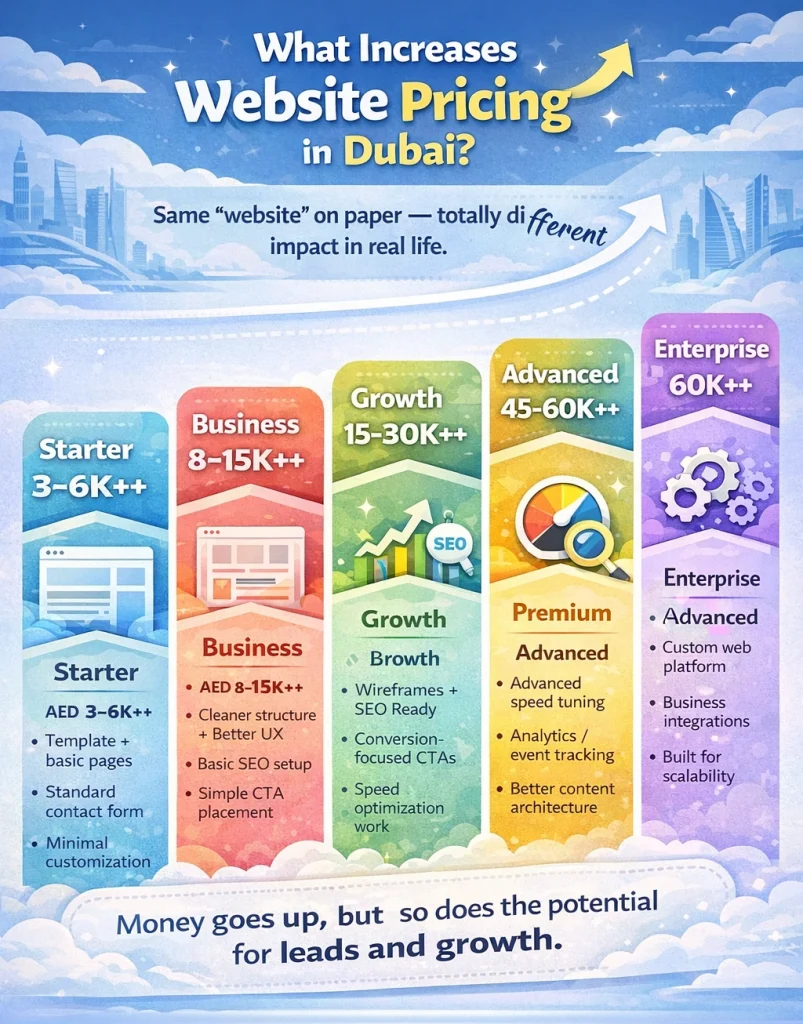
A website can be a basic online presence, or it can be built like a lead engine. These blocks help readers understand what changes as pricing goes up — in a clear, visual way.
One is built to “exist”. The other is built to guide decisions, build trust, and convert.
Most cheap builds skip performance work. That’s why they feel heavy and don’t rank well.
If you redesign in 6–12 months because it doesn’t convert, the “cheap” option wasn’t cheap.
Many clients assume speed and performance come naturally with any website.
They don’t.
Lower-cost websites may launch with heavy image files, excessive JavaScript, poorly configured caching, and no server-side optimization. The result is slower load times, higher bounce rates, weaker Google rankings, and lower conversion rates.
More expensive projects often include detailed image compression systems, script cleanup, CDN configuration, caching strategy, hosting consultation, and database optimization.
Speed is not decoration.
Speed affects perception, rankings, and revenue.
And optimizing performance properly requires time and expertise.
Some businesses already have established brand guidelines — a defined logo, color system, typography structure, and consistent tone of voice.
Others don’t.
If the agency must help define positioning, clarify messaging, structure visual hierarchy, and refine brand voice, the project scope expands significantly. That process moves beyond web design and into brand development.
Brand clarity influences how your business is perceived in a competitive market like Dubai. And strategic brand work is reflected in pricing.
Same “website” on paper — totally different outcome in real life.
Sometimes a AED 4,000 website isn’t necessarily bad — it’s simply incomplete.
You may save money upfront. But if the site doesn’t convert properly, doesn’t rank organically, doesn’t scale with your growth, doesn’t integrate with your CRM, or requires redesign within a year, you end up rebuilding.
Rebuilding costs more than building correctly once.
That’s where the real price difference becomes visible.
At the higher end, projects evolve into full digital systems rather than simple websites. These builds may include custom backend logic, advanced security layers, multilingual architecture, extensive content clustering for SEO, funnel mapping, heatmap integration, analytics dashboards, and structured A/B testing frameworks.
These are not brochure sites.
They are infrastructure.
And infrastructure pricing reflects complexity, responsibility, and expected business impact.
Instead of asking, “How much does a website cost?” ask a more strategic question:
“What does this website need to achieve?”
If the goal is basic online presence, AED 3,000 to AED 6,000 may be sufficient.
If the goal is structured lead generation with SEO foundations, AED 15,000 to AED 30,000 is realistic.
If the goal is a performance-driven growth platform that supports scaling, automation, and advanced strategy, AED 40,000 and above makes sense.
The more revenue responsibility you assign to the website, the more strategic the build needs to be.
Website pricing is not random.
It reflects depth of thinking, technical execution, SEO integration, conversion structure, branding clarity, performance optimization, and scalability planning.
Two websites can look similar on the surface.
But underneath, one is structured for growth, while the other is structured to exist.
In competitive markets like Dubai, that difference becomes very visible over time. The strategically built website continues generating qualified leads and supporting business expansion. The cheaply built one often becomes a redesign project sooner than expected.

SEORISE brings over 12 years of hands-on experience, powered by a professional team of 30 specialists focused on delivering measurable growth, performance-driven strategy, and long-term digital success.
© 2026 — SEORISE. All Rights Reserved.

