
Clarity
Above the fold
Headline That Actually Explains
One clear sentence that tells the user what you sell and why it matters.
There’s a quiet shift happening across almost every industry right now, and the most dangerous part about it is that many businesses don’t notice it until the impact is already visible in their numbers. It doesn’t arrive loudly. It doesn’t announce itself. It just slowly changes how people behave online.
The shift is simple, but powerful: people don’t browse the internet the way they used to. They search with intent.
They don’t open Google out of boredom. They open it because they want something specific. A solution to a problem. A service provider they can trust. A product they’re ready to compare. A clear answer to a question that matters.
And when they search, they don’t scroll endlessly. They click one of the first few results they see. Not the tenth result. Not something buried on page two. Not the brand that “has a nice website” but doesn’t appear where it counts.
If your website doesn’t show up in those decision-making moments, you’re not just missing random traffic. You’re missing people who are actively looking to buy. And that’s exactly why SEO matters.
Think about how decisions are made today.
Nobody wakes up and says, “Let me randomly explore some websites and see what I discover.” That’s not how buying behavior works anymore. Instead, people search with purpose.
They type things like:
“best accounting firm for small business”
“SEO agency pricing”
“luxury watches for sale”
“web design company near me”
“how to improve website sales”
Those are not casual searches. Those are decision-stage searches.
When someone types a query like that, they are already in evaluation mode. They’re comparing options. They’re checking credibility. They’re narrowing down choices. In many cases, they’re preparing to spend money.
If your business does not appear in that comparison set, you’re not even being considered. And if you’re not being considered, you can’t win the deal — no matter how strong your service actually is.
SEO puts you inside that moment. It places your business in the room before the conversation moves forward and before your competitors close the door.
Visibility builds first. Then trust, clicks, and qualified leads follow as your site earns authority.
Many companies invest heavily in design — and that’s absolutely valuable. They build something modern, clean, fast, and visually impressive. They focus on branding, typography, layout, and aesthetics. On the surface, everything looks professional.
And then they stop there.
They assume that because the website looks polished, people will somehow find it naturally.
But that’s not how digital discovery works.
A website without SEO is like opening a premium store in the middle of the desert and hoping someone accidentally drives past it. You can have perfect lighting, a beautiful interior, and excellent staff — but if there’s no road leading to your location, none of it matters.
SEO builds that road.
It connects your website to existing demand. It connects your pages to real search intent. Without that connection, your website exists, but it doesn’t operate as a growth engine.
Paid advertising absolutely has its place. It can generate traffic quickly. It can test offers and messaging. It can accelerate campaigns and create short-term spikes in attention.
But the moment you stop paying, the traffic stops. There is no residual effect. There is no compounding. There is no long-term momentum.
SEO works differently.
When your website ranks organically for relevant, high-intent keywords, you don’t have to pay for every single click. The visibility continues. The traffic builds gradually. The authority strengthens over time.
It’s slower at the beginning, yes. There’s no overnight explosion. But long term, SEO becomes one of the most cost-efficient growth channels available because the results compound rather than reset.
Businesses that rely only on ads are renting attention.
Businesses that invest in SEO are building digital assets.
And assets increase in value over time.
There’s something subtle that happens psychologically when someone sees your company ranking at the top of Google’s organic results.
They assume credibility.
They assume stability.
They assume authority.
Nobody openly says, “I trust them because they rank high,” but the perception forms automatically. Companies that appear consistently at the top feel established. They feel legitimate. They feel like leaders.
Ranking is not just about traffic volume.
It’s about positioning.
If someone searches for “best SEO agency” and your company appears organically — not as an ad, but as a natural result — you enter the conversation with built-in trust. That trust shortens sales cycles. It reduces hesitation. It increases conversion rates.
SEO influences perception long before the first email or phone call ever happens.
Not all traffic carries the same value.
You can run broad ads and attract thousands of visitors who are mildly curious but not committed. Or you can rank organically for high-intent phrases and attract fewer visitors who are significantly more qualified.
Someone searching “what is digital marketing” is exploring.
Someone searching “hire digital marketing agency in Dubai” is preparing to act.
SEO allows you to target different stages of intent:
Informational.
Comparative.
Transactional.
When structured correctly, your website can guide users from learning to comparing to buying — all within your ecosystem. That’s not random traffic. That’s structured demand capture.
Many businesses still think SEO means inserting keywords into content repeatedly. That approach is outdated and ineffective.
Modern SEO is about structure.
It’s about clear site architecture, fast load times, internal linking that makes sense, helpful content that answers real questions, strong technical health, mobile usability, structured data, and topical authority.
Search engines are trying to recommend the most useful and reliable websites to users. If your pages are thin, your structure is confusing, or your content doesn’t genuinely help, you won’t rank — no matter how many keywords you force into the text.
In that sense, SEO pushes you to improve your website.
It forces clarity. It demands organization. It rewards depth. And as a side effect, those improvements enhance user experience and conversion rates as well.
The danger of ignoring SEO is not dramatic failure. It’s slow erosion.
You won’t wake up to a sudden crash. Instead, you’ll notice subtle changes over time.
A competitor begins ranking for more keywords. They start publishing more content. They earn more backlinks. They build stronger authority. They receive more organic inquiries.
Gradually, they become the default option in your market.
By the time you decide to “start SEO,” they’ve built a head start that can’t be closed overnight. SEO rewards consistency and patience. It compounds over time.
Waiting doesn’t pause the race.
It simply means someone else continues running.
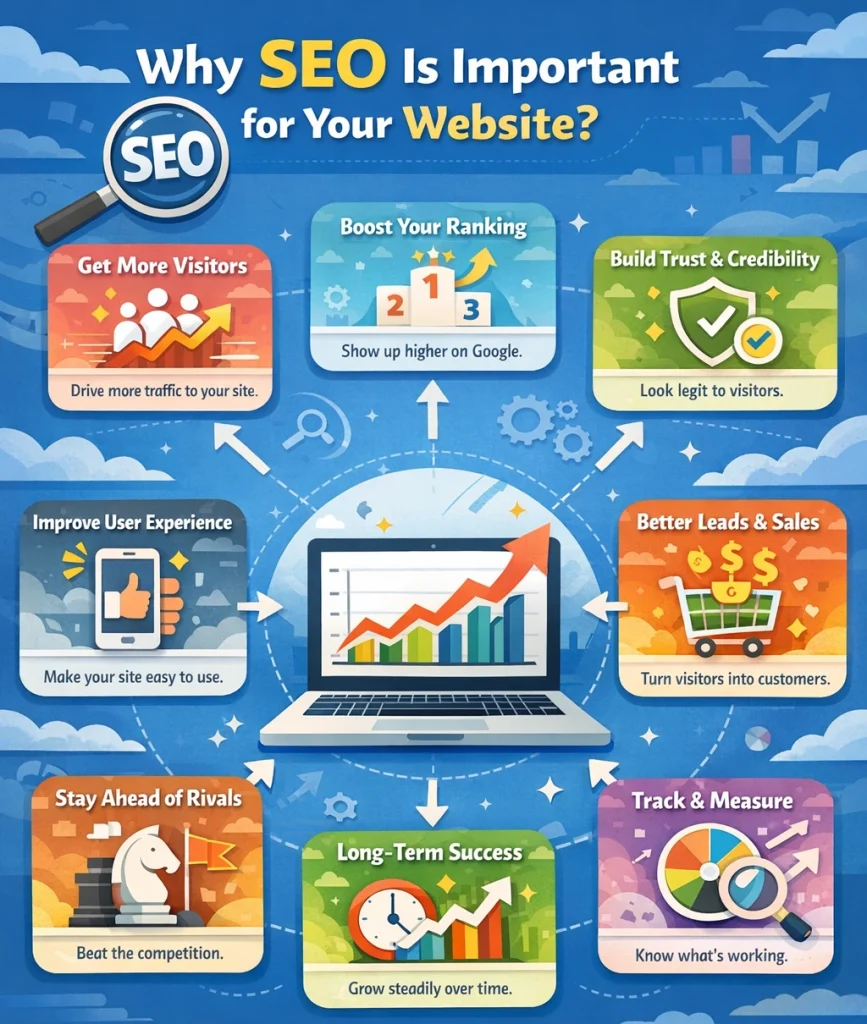
These are visual content blocks you can drop into any page to add clarity, structure, and a premium feel.
One clear sentence that tells the user what you sell and why it matters.
Short proof sections: results, testimonials, clients, guarantees, real photos.
Compress hero images and keep sections clean so the page feels fast.
Short form, clear CTA, and one fast option like WhatsApp makes it easier to act.
Rank for phrases that show intent — “pricing”, “best”, “hire”, “near me”.
Use short sections, bullet points, and mini callouts so people don’t skim past.
Place CTAs right after value + proof, not randomly at the end.
CTA clicks, scroll depth, conversions — not just views and impressions.
Here’s something often overlooked: SEO doesn’t compete with other marketing efforts. It strengthens them.
If someone clicks your ad, they may Google your brand afterward.
If someone discovers you on Instagram, they often search your name.
If someone receives a referral, they check your website.
What happens if they search and find weak rankings, thin content, or low authority?
Doubt.
Strong SEO by SEORISE reinforces brand credibility. It supports PR efforts, social campaigns, paid advertising, and email marketing. Because in reality, almost every digital journey eventually touches a search engine.
When your search presence is strong, every other channel performs better.
When you understand which keywords drive revenue, which pages convert best, and which topics attract qualified leads, you gain clarity.
SEO provides data about real demand. It reveals what your audience is actively searching for — not what you assume they care about.
That insight allows for smarter content decisions, clearer service positioning, better budget allocation, and more confident forecasting.
It transforms marketing from guesswork into strategy.

SEORISE brings over 12 years of hands-on experience, powered by a professional team of 30 specialists focused on delivering measurable growth, performance-driven strategy, and long-term digital success.
© 2026 — SEORISE. All Rights Reserved.

