
Clear Value Proposition
Above the fold, users should instantly understand what you sell and why it’s worth it.
Let’s be honest for a moment.
When sales start dropping or leads slow down, most businesses immediately jump to the same conclusion: “We need more traffic.” The instinct is almost automatic. Run more ads. Increase the budget. Push harder. Get more clicks. Get more impressions. Get more eyeballs on the site.
But here’s the uncomfortable truth that many businesses avoid facing: traffic does not fix a weak website.
If your structure is confusing, if your message is unclear, if your pages don’t guide users toward a logical next step, then doubling your traffic won’t double your sales. It will simply expose more people to the same friction, the same confusion, and the same hesitation. In other words, it doesn’t solve the problem — it amplifies it.
So instead of reacting emotionally, let’s break this down properly.
In most cases, increasing website sales comes down to two core areas working together in alignment: smart web design and strategic SEO Services. Not separately. Not randomly. Together.
Imagine walking into a physical store where nothing is clearly labeled, the staff doesn’t greet you, the pricing is unclear, and the checkout counter is hidden somewhere in the back behind a shelf. Even if the products are good, you probably wouldn’t buy. You’d feel uncertain, slightly frustrated, maybe even skeptical.
Websites work the exact same way.
Before thinking about rankings, campaigns, or traffic sources, you have to look at the experience your current visitors are having. Because if that experience isn’t smooth, adding more people into it won’t help.
Ask yourself honestly:
Is it immediately obvious what we sell within the first few seconds?
Is pricing structured clearly enough to reduce hesitation?
Are the benefits stronger and clearer than the technical features?
Is the call-to-action positioned naturally and confidently?
Does the overall page feel trustworthy and maintained?
Small adjustments in clarity often produce disproportionately large increases in conversion rates. Sometimes it’s not about rebuilding the entire website from scratch. It’s about tightening the message, removing visual clutter, repositioning a button, simplifying a headline, or reorganizing content so it flows logically.
Sales increase when confusion decreases. That principle rarely fails.
Many websites are structured like digital brochures. They follow a predictable pattern: About us. Services. Contact. And while that structure feels logical from a company’s perspective, it doesn’t necessarily reflect how users think when they land on a page.
Users don’t think in menu categories. They think in decisions.
They ask themselves questions like:
“Is this right for me?”
“Can I trust this company?”
“Is this worth the investment?”
Your website should answer those questions gradually and naturally as someone scrolls down the page. That requires intentional sequencing.
Benefits should come before deep details.
Proof should appear before pressure.
Your value proposition should be visible above the fold.
Testimonials should reinforce claims at strategic points.
Calls-to-action should feel like the next logical step — not like interruptions.
Design is not decoration. It’s structure. And structure influences how confidently someone moves toward a decision.
When sequencing improves, sales often follow.
Let’s keep this simple and practical.
If your website loads slowly, people leave. They don’t send feedback. They don’t complain. They don’t explain why they exited. They just close the tab and move on.
Speed directly impacts bounce rate, time on page, and conversion rate. It also influences search rankings. But beyond the metrics, speed affects perception.
A fast website feels stable and professional.
A slow website feels unreliable and risky.
And people rarely buy from something that feels risky.
Optimizing images, cleaning unnecessary code, reducing heavy scripts, improving hosting performance — these aren’t just technical improvements. They directly influence revenue.
When speed increases, friction decreases. When friction decreases, conversions rise.
Typical pattern: visibility grows first, then leads and sales follow as UX, speed, and trust signals improve.
Now we move into SEO, but not in the way most businesses think about it.
SEO is not about ranking for random keywords that generate traffic numbers. It’s about ranking for intent.
There is a significant difference between someone searching “What is web design?” and someone searching “Hire web design company.” The first search is informational. The second is commercial.
If your SEO strategy targets the wrong type of intent, you might get traffic — but not sales.
High-converting SEO focuses on:
Service-based keywords.
Location-based searches when relevant.
Problem-solving phrases.
Comparison keywords.
“Best,” “pricing,” and “near me” variations.
Traffic quality matters more than traffic volume.
You don’t need 10,000 visitors who are casually browsing. You need the right 500 who are actively looking for what you offer.
This is where many businesses unintentionally disconnect their strategy.
They create blog content to attract traffic. Then they build service pages separately. But those two parts rarely support each other properly.
Content should guide users deeper into your ecosystem.
For example, if someone reads a blog post about improving online visibility, that page should naturally link to your SEO service page. If someone reads a comparison article about website platforms, that should lead toward your web design service page.
SEO’s job is to bring people in.
Design’s job is to convert them.
If those two systems are not aligned, you are leaking opportunities at every stage.
Sales depend heavily on trust. And trust is often formed within seconds.
Ask yourself:
Are testimonials clearly visible and credible?
Do you showcase real results instead of vague claims?
Are case studies structured and easy to understand?
Is your contact information accessible and reassuring?
Does your site look updated and maintained?
Even subtle design elements matter more than people realize. Professional typography. Consistent spacing. Clean layout. Real photography instead of generic stock images.
Trust is built visually before it’s confirmed logically.
People make emotional decisions first. Then they justify those decisions rationally. Your website should support both processes simultaneously.
Sometimes the real issue isn’t traffic or design quality. It’s friction.
Long contact forms.
Unclear pricing.
Complicated checkout flows.
Slow response times.
Each additional step introduces hesitation. Each hesitation reduces conversions.
Reducing friction might mean shortening your forms, offering WhatsApp contact options, clarifying pricing ranges, adding FAQs near call-to-action sections, or offering a free consultation.
Make it easy to say yes.
Because every unnecessary step makes it easier to say no.
Small improvements to structure and messaging often lift conversion without needing more traffic.
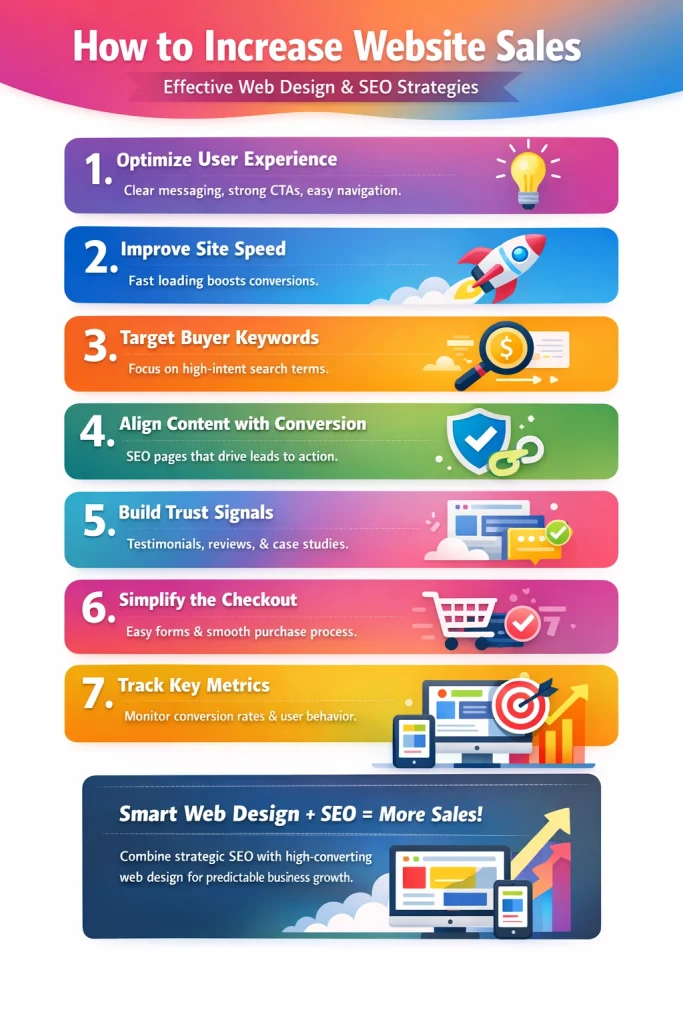
Above the fold, users should instantly understand what you sell and why it’s worth it.
Fast pages reduce bounce, improve trust, and help rankings — directly impacting revenue.
Testimonials, proof, and clear contact details should appear before the user hesitates.
Short forms, clear pricing ranges, and WhatsApp-style CTAs increase conversion.
Rank for buying intent keywords — not just educational traffic that never converts.
Track conversion rate, CTA clicks, scroll depth — and optimize the bottlenecks.
Not all metrics deserve equal attention.
Impressions and raw traffic numbers can look impressive, but they don’t automatically translate to revenue. Instead, focus on metrics that influence business growth directly:
Conversion rate.
Cost per lead.
Bounce rate.
Scroll depth.
Click-through rate on key CTAs.
If traffic increases but conversion drops, something is misaligned.
If traffic remains stable but conversion improves, you are moving in the right direction.
Often, real growth comes from optimizing existing traffic before investing heavily in acquiring new traffic.
When both systems operate in alignment, the impact becomes clear.
SEO by SEORISE attracts users who are actively searching for solutions.
Web design guides them toward logical action.
Speed reinforces professionalism.
Structure reduces hesitation.
Trust elements strengthen confidence.
The result isn’t random.
It’s more qualified leads, higher conversion rates, and stronger return on every click — not because of tricks or aggressive marketing tactics, but because of clarity and alignment.
If your website isn’t generating the level of sales it should, resist the urge to immediately blame traffic.
Start by evaluating:
Your structure.
Your speed.
Your messaging.
Your intent alignment.
Your trust signals.
Often, the solution isn’t louder marketing or a bigger ad budget. It’s smarter design and focused SEO working together intentionally.
When those two areas align, growth stops feeling unpredictable.
It becomes measurable.
It becomes scalable.
And most importantly, it becomes repeatable.
And repeatable growth is what every serious business ultimately wants.

SEORISE brings over 12 years of hands-on experience, powered by a professional team of 30 specialists focused on delivering measurable growth, performance-driven strategy, and long-term digital success.
© 2026 — SEORISE. All Rights Reserved.

