
Starter site
“I just need a website”
What you usually get
- Theme + page builder layout
- Basic pages + contact form
- Minimal custom sections
- Limited SEO structure
Best for:
simple presence
If you’ve ever requested website design quotes in Dubai, you’ve probably felt that initial confusion that almost everyone experiences. One agency confidently says AED 3,000. Another sends a proposal for AED 12,000. A third presents a detailed offer for AED 45,000 or more. And despite the massive price gap, they all describe their service the same way: “Complete website design.”
Naturally, that raises an important question.
How can the same service carry such dramatically different price tags?
The answer is simpler than it looks, and more layered than most people realize.
You’re not paying for pages. You’re not paying for the number of buttons, sections, or animations. You’re paying for depth of thinking, strategic clarity, structural planning, technical execution, and long-term business impact.
A website is not just a collection of design files and code. It can either function as a digital brochure that quietly sits online, or it can operate as a revenue-generating system that actively drives growth.
And that difference changes everything, including the price.
Before discussing pricing, we need to clarify intent.
Some websites are built simply to exist. They include a homepage, an about page, a services page, and a contact form. They look decent. They function properly. They’re mobile responsive. They check the basic boxes.
In Dubai, that kind of website typically falls within the AED 3,000 to AED 6,000 range, especially when it’s built using a pre-designed template with limited customization.
For certain small businesses, that’s perfectly acceptable. If the goal is basic online presence, just something professional enough to send to clients, then that price point can make sense.
But here’s the real question that changes everything:
Is the website meant to simply “be there”… or is it expected to consistently generate leads and influence revenue?
Because the moment the objective shifts from presence to performance, the pricing shifts as well.
Not all “websites” are the same product. The price usually reflects strategy depth, SEO readiness, and performance work.
At the lower end of the pricing spectrum — roughly AED 3,000 to AED 8,000 — most projects rely heavily on efficiency. They’re built using pre-designed WordPress themes, standard layouts, and widely available page builders. Customization is minimal. User experience thinking is basic. Contact forms are functional but simple.
There is nothing inherently wrong with templates. They are fast, cost-effective, and practical. For certain use cases, they are completely adequate.
However, templates don’t analyze your positioning in the market. They don’t map your conversion flow. They don’t evaluate your competitors’ strengths. They don’t consider your audience’s psychology. They don’t build SEO services structure around search intent.
They give you a website.
They don’t build you a system.
Now compare that with a project priced between AED 15,000 and AED 35,000. In that range, you’re typically paying for strategic thinking before design even begins. Wireframes are created. User journeys are mapped. Page structure is aligned with conversion goals. SEO architecture is considered from day one. Calls-to-action are placed deliberately. Speed and performance are addressed properly.
At that point, you’re not just buying design.
You’re investing in structured business logic applied to digital infrastructure.
A website can look visually impressive and still underperform financially. That happens more often than people think.
Design aesthetics and conversion strategy are two completely different skill sets. Lower-cost projects often prioritize visual appeal — color palettes, typography choices, animations, and general layout polish. The site looks modern. It feels updated.
But higher-level projects focus on how people move through the page. They analyze friction points. They strategically place trust signals. They structure content sequencing to reduce hesitation. They test CTA timing. They consider scroll behavior and psychological triggers.
In simple terms, one website is built to impress visitors.
The other is built to guide them toward action.
And guidance increases revenue.
Another major factor influencing website pricing is SEO integration.
A website built around AED 5,000 typically does not include structured keyword research, search intent mapping, internal linking logic, or technical SEO depth. Headings may not be optimized strategically. Metadata might be basic or auto-generated. URL structure may not be carefully planned.
In contrast, a project priced AED 20,000 or more often includes keyword mapping before design begins, SEO-friendly architecture planning, structured content blocks aligned with high-intent queries, schema implementation, and Core Web Vitals optimization.
When SEO is integrated from the beginning, the website is not just visually appealing — it becomes discoverable.
Search visibility directly influences long-term revenue potential. And that integration requires planning, research, and technical expertise.
How a website is built also significantly impacts pricing.
Lower-cost websites often rely entirely on page builders and standard plugin stacks. Backend customization is limited. Functionality is mostly dependent on pre-built tools.
Higher-budget projects may involve custom-coded components, optimized lightweight sections, advanced dynamic content, API integrations, automation systems, CRM connections, and structured event tracking.
At that level, you’re not paying simply for additional design time. You’re paying for engineering depth and architectural stability.
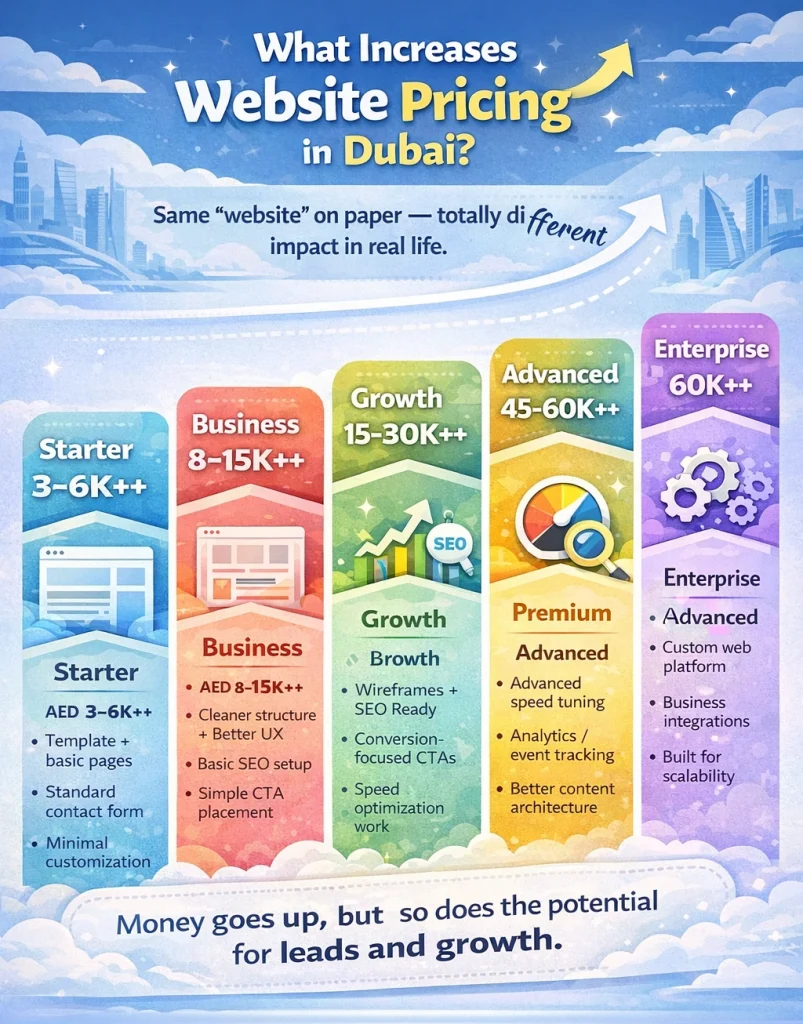
A website can be a basic online presence, or it can be built like a lead engine. These blocks help readers understand what changes as pricing goes up — in a clear, visual way.
One is built to “exist”. The other is built to guide decisions, build trust, and convert.
Most cheap builds skip performance work. That’s why they feel heavy and don’t rank well.
If you redesign in 6–12 months because it doesn’t convert, the “cheap” option wasn’t cheap.
Many clients assume speed and performance come naturally with any website.
They don’t.
Lower-cost websites may launch with heavy image files, excessive JavaScript, poorly configured caching, and no server-side optimization. The result is slower load times, higher bounce rates, weaker Google rankings, and lower conversion rates.
More expensive projects often include detailed image compression systems, script cleanup, CDN configuration, caching strategy, hosting consultation, and database optimization.
Speed is not decoration.
Speed affects perception, rankings, and revenue.
And optimizing performance properly requires time and expertise.
Some businesses already have established brand guidelines — a defined logo, color system, typography structure, and consistent tone of voice.
Others don’t.
If the agency must help define positioning, clarify messaging, structure visual hierarchy, and refine brand voice, the project scope expands significantly. That process moves beyond web design and into brand development.
Brand clarity influences how your business is perceived in a competitive market like Dubai. And strategic brand work is reflected in pricing.
Same “website” on paper — totally different outcome in real life.
Sometimes a AED 4,000 website isn’t necessarily bad — it’s simply incomplete.
You may save money upfront. But if the site doesn’t convert properly, doesn’t rank organically, doesn’t scale with your growth, doesn’t integrate with your CRM, or requires redesign within a year, you end up rebuilding.
Rebuilding costs more than building correctly once.
That’s where the real price difference becomes visible.
At the higher end, projects evolve into full digital systems rather than simple websites. These builds may include custom backend logic, advanced security layers, multilingual architecture, extensive content clustering for SEO, funnel mapping, heatmap integration, analytics dashboards, and structured A/B testing frameworks.
These are not brochure sites.
They are infrastructure.
And infrastructure pricing reflects complexity, responsibility, and expected business impact.
Instead of asking, “How much does a website cost?” ask a more strategic question:
“What does this website need to achieve?”
If the goal is basic online presence, AED 3,000 to AED 6,000 may be sufficient.
If the goal is structured lead generation with SEO foundations, AED 15,000 to AED 30,000 is realistic.
If the goal is a performance-driven growth platform that supports scaling, automation, and advanced strategy, AED 40,000 and above makes sense.
The more revenue responsibility you assign to the website, the more strategic the build needs to be.
Website pricing is not random.
It reflects depth of thinking, technical execution, SEO integration, conversion structure, branding clarity, performance optimization, and scalability planning.
Two websites can look similar on the surface.
But underneath, one is structured for growth, while the other is structured to exist.
In competitive markets like Dubai, that difference becomes very visible over time. The strategically built website continues generating qualified leads and supporting business expansion. The cheaply built one often becomes a redesign project sooner than expected.

There’s a quiet shift happening across almost every industry right now, and the most dangerous part about it is that many businesses don’t notice it until the impact is already visible in their numbers. It doesn’t arrive loudly. It doesn’t announce itself. It just slowly changes how people behave online.
The shift is simple, but powerful: people don’t browse the internet the way they used to. They search with intent.
They don’t open Google out of boredom. They open it because they want something specific. A solution to a problem. A service provider they can trust. A product they’re ready to compare. A clear answer to a question that matters.
And when they search, they don’t scroll endlessly. They click one of the first few results they see. Not the tenth result. Not something buried on page two. Not the brand that “has a nice website” but doesn’t appear where it counts.
If your website doesn’t show up in those decision-making moments, you’re not just missing random traffic. You’re missing people who are actively looking to buy. And that’s exactly why SEO matters.
Think about how decisions are made today.
Nobody wakes up and says, “Let me randomly explore some websites and see what I discover.” That’s not how buying behavior works anymore. Instead, people search with purpose.
They type things like:
“best accounting firm for small business”
“SEO agency pricing”
“luxury watches for sale”
“web design company near me”
“how to improve website sales”
Those are not casual searches. Those are decision-stage searches.
When someone types a query like that, they are already in evaluation mode. They’re comparing options. They’re checking credibility. They’re narrowing down choices. In many cases, they’re preparing to spend money.
If your business does not appear in that comparison set, you’re not even being considered. And if you’re not being considered, you can’t win the deal — no matter how strong your service actually is.
SEO puts you inside that moment. It places your business in the room before the conversation moves forward and before your competitors close the door.
Visibility builds first. Then trust, clicks, and qualified leads follow as your site earns authority.
Many companies invest heavily in design — and that’s absolutely valuable. They build something modern, clean, fast, and visually impressive. They focus on branding, typography, layout, and aesthetics. On the surface, everything looks professional.
And then they stop there.
They assume that because the website looks polished, people will somehow find it naturally.
But that’s not how digital discovery works.
A website without SEO is like opening a premium store in the middle of the desert and hoping someone accidentally drives past it. You can have perfect lighting, a beautiful interior, and excellent staff — but if there’s no road leading to your location, none of it matters.
SEO builds that road.
It connects your website to existing demand. It connects your pages to real search intent. Without that connection, your website exists, but it doesn’t operate as a growth engine.
Paid advertising absolutely has its place. It can generate traffic quickly. It can test offers and messaging. It can accelerate campaigns and create short-term spikes in attention.
But the moment you stop paying, the traffic stops. There is no residual effect. There is no compounding. There is no long-term momentum.
SEO works differently.
When your website ranks organically for relevant, high-intent keywords, you don’t have to pay for every single click. The visibility continues. The traffic builds gradually. The authority strengthens over time.
It’s slower at the beginning, yes. There’s no overnight explosion. But long term, SEO becomes one of the most cost-efficient growth channels available because the results compound rather than reset.
Businesses that rely only on ads are renting attention.
Businesses that invest in SEO are building digital assets.
And assets increase in value over time.
There’s something subtle that happens psychologically when someone sees your company ranking at the top of Google’s organic results.
They assume credibility.
They assume stability.
They assume authority.
Nobody openly says, “I trust them because they rank high,” but the perception forms automatically. Companies that appear consistently at the top feel established. They feel legitimate. They feel like leaders.
Ranking is not just about traffic volume.
It’s about positioning.
If someone searches for “best SEO agency” and your company appears organically — not as an ad, but as a natural result — you enter the conversation with built-in trust. That trust shortens sales cycles. It reduces hesitation. It increases conversion rates.
SEO influences perception long before the first email or phone call ever happens.
Not all traffic carries the same value.
You can run broad ads and attract thousands of visitors who are mildly curious but not committed. Or you can rank organically for high-intent phrases and attract fewer visitors who are significantly more qualified.
Someone searching “what is digital marketing” is exploring.
Someone searching “hire digital marketing agency in Dubai” is preparing to act.
SEO allows you to target different stages of intent:
Informational.
Comparative.
Transactional.
When structured correctly, your website can guide users from learning to comparing to buying — all within your ecosystem. That’s not random traffic. That’s structured demand capture.
Many businesses still think SEO means inserting keywords into content repeatedly. That approach is outdated and ineffective.
Modern SEO is about structure.
It’s about clear site architecture, fast load times, internal linking that makes sense, helpful content that answers real questions, strong technical health, mobile usability, structured data, and topical authority.
Search engines are trying to recommend the most useful and reliable websites to users. If your pages are thin, your structure is confusing, or your content doesn’t genuinely help, you won’t rank — no matter how many keywords you force into the text.
In that sense, SEO pushes you to improve your website.
It forces clarity. It demands organization. It rewards depth. And as a side effect, those improvements enhance user experience and conversion rates as well.
The danger of ignoring SEO is not dramatic failure. It’s slow erosion.
You won’t wake up to a sudden crash. Instead, you’ll notice subtle changes over time.
A competitor begins ranking for more keywords. They start publishing more content. They earn more backlinks. They build stronger authority. They receive more organic inquiries.
Gradually, they become the default option in your market.
By the time you decide to “start SEO,” they’ve built a head start that can’t be closed overnight. SEO rewards consistency and patience. It compounds over time.
Waiting doesn’t pause the race.
It simply means someone else continues running.
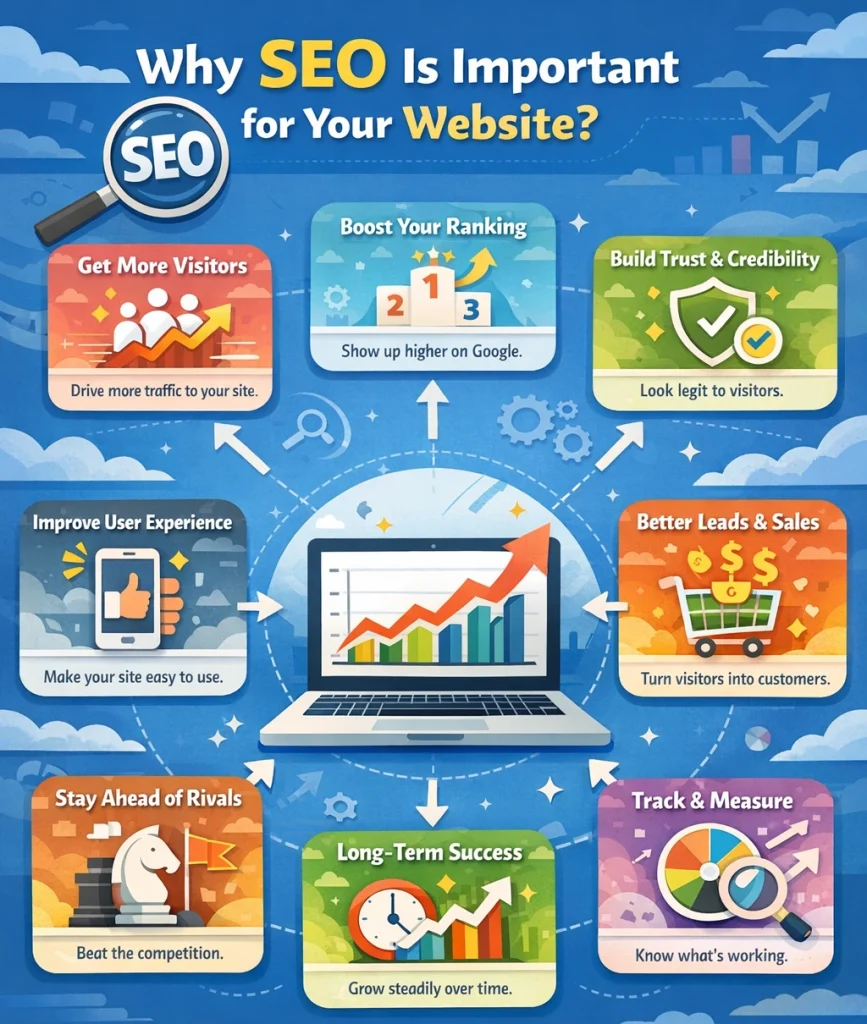
These are visual content blocks you can drop into any page to add clarity, structure, and a premium feel.
One clear sentence that tells the user what you sell and why it matters.
Short proof sections: results, testimonials, clients, guarantees, real photos.
Compress hero images and keep sections clean so the page feels fast.
Short form, clear CTA, and one fast option like WhatsApp makes it easier to act.
Rank for phrases that show intent — “pricing”, “best”, “hire”, “near me”.
Use short sections, bullet points, and mini callouts so people don’t skim past.
Place CTAs right after value + proof, not randomly at the end.
CTA clicks, scroll depth, conversions — not just views and impressions.
Here’s something often overlooked: SEO doesn’t compete with other marketing efforts. It strengthens them.
If someone clicks your ad, they may Google your brand afterward.
If someone discovers you on Instagram, they often search your name.
If someone receives a referral, they check your website.
What happens if they search and find weak rankings, thin content, or low authority?
Doubt.
Strong SEO by SEORISE reinforces brand credibility. It supports PR efforts, social campaigns, paid advertising, and email marketing. Because in reality, almost every digital journey eventually touches a search engine.
When your search presence is strong, every other channel performs better.
When you understand which keywords drive revenue, which pages convert best, and which topics attract qualified leads, you gain clarity.
SEO provides data about real demand. It reveals what your audience is actively searching for — not what you assume they care about.
That insight allows for smarter content decisions, clearer service positioning, better budget allocation, and more confident forecasting.
It transforms marketing from guesswork into strategy.
Let’s be honest for a moment.
When sales start dropping or leads slow down, most businesses immediately jump to the same conclusion: “We need more traffic.” The instinct is almost automatic. Run more ads. Increase the budget. Push harder. Get more clicks. Get more impressions. Get more eyeballs on the site.
But here’s the uncomfortable truth that many businesses avoid facing: traffic does not fix a weak website.
If your structure is confusing, if your message is unclear, if your pages don’t guide users toward a logical next step, then doubling your traffic won’t double your sales. It will simply expose more people to the same friction, the same confusion, and the same hesitation. In other words, it doesn’t solve the problem — it amplifies it.
So instead of reacting emotionally, let’s break this down properly.
In most cases, increasing website sales comes down to two core areas working together in alignment: smart web design and strategic SEO Services. Not separately. Not randomly. Together.
Imagine walking into a physical store where nothing is clearly labeled, the staff doesn’t greet you, the pricing is unclear, and the checkout counter is hidden somewhere in the back behind a shelf. Even if the products are good, you probably wouldn’t buy. You’d feel uncertain, slightly frustrated, maybe even skeptical.
Websites work the exact same way.
Before thinking about rankings, campaigns, or traffic sources, you have to look at the experience your current visitors are having. Because if that experience isn’t smooth, adding more people into it won’t help.
Ask yourself honestly:
Is it immediately obvious what we sell within the first few seconds?
Is pricing structured clearly enough to reduce hesitation?
Are the benefits stronger and clearer than the technical features?
Is the call-to-action positioned naturally and confidently?
Does the overall page feel trustworthy and maintained?
Small adjustments in clarity often produce disproportionately large increases in conversion rates. Sometimes it’s not about rebuilding the entire website from scratch. It’s about tightening the message, removing visual clutter, repositioning a button, simplifying a headline, or reorganizing content so it flows logically.
Sales increase when confusion decreases. That principle rarely fails.
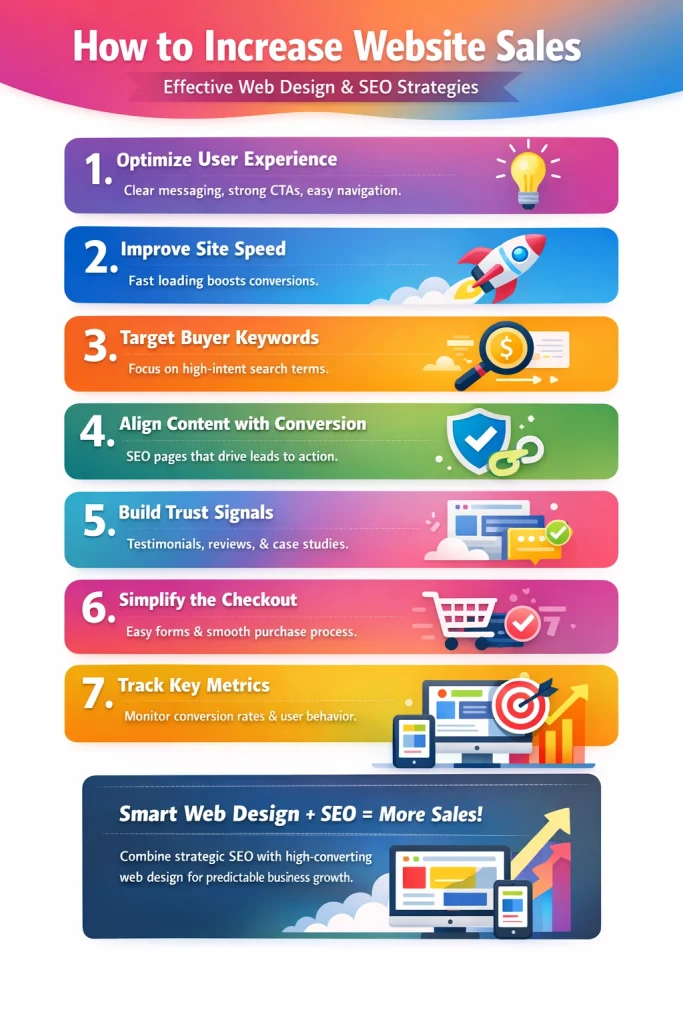
Many websites are structured like digital brochures. They follow a predictable pattern: About us. Services. Contact. And while that structure feels logical from a company’s perspective, it doesn’t necessarily reflect how users think when they land on a page.
Users don’t think in menu categories. They think in decisions.
They ask themselves questions like:
“Is this right for me?”
“Can I trust this company?”
“Is this worth the investment?”
Your website should answer those questions gradually and naturally as someone scrolls down the page. That requires intentional sequencing.
Benefits should come before deep details.
Proof should appear before pressure.
Your value proposition should be visible above the fold.
Testimonials should reinforce claims at strategic points.
Calls-to-action should feel like the next logical step — not like interruptions.
Design is not decoration. It’s structure. And structure influences how confidently someone moves toward a decision.
When sequencing improves, sales often follow.
Let’s keep this simple and practical.
If your website loads slowly, people leave. They don’t send feedback. They don’t complain. They don’t explain why they exited. They just close the tab and move on.
Speed directly impacts bounce rate, time on page, and conversion rate. It also influences search rankings. But beyond the metrics, speed affects perception.
A fast website feels stable and professional.
A slow website feels unreliable and risky.
And people rarely buy from something that feels risky.
Optimizing images, cleaning unnecessary code, reducing heavy scripts, improving hosting performance — these aren’t just technical improvements. They directly influence revenue.
When speed increases, friction decreases. When friction decreases, conversions rise.
Typical pattern: visibility grows first, then leads and sales follow as UX, speed, and trust signals improve.
Now we move into SEO, but not in the way most businesses think about it.
SEO is not about ranking for random keywords that generate traffic numbers. It’s about ranking for intent.
There is a significant difference between someone searching “What is web design?” and someone searching “Hire web design company.” The first search is informational. The second is commercial.
If your SEO strategy targets the wrong type of intent, you might get traffic — but not sales.
High-converting SEO focuses on:
Service-based keywords.
Location-based searches when relevant.
Problem-solving phrases.
Comparison keywords.
“Best,” “pricing,” and “near me” variations.
Traffic quality matters more than traffic volume.
You don’t need 10,000 visitors who are casually browsing. You need the right 500 who are actively looking for what you offer.
This is where many businesses unintentionally disconnect their strategy.
They create blog content to attract traffic. Then they build service pages separately. But those two parts rarely support each other properly.
Content should guide users deeper into your ecosystem.
For example, if someone reads a blog post about improving online visibility, that page should naturally link to your SEO service page. If someone reads a comparison article about website platforms, that should lead toward your web design service page.
SEO’s job is to bring people in.
Design’s job is to convert them.
If those two systems are not aligned, you are leaking opportunities at every stage.
Sales depend heavily on trust. And trust is often formed within seconds.
Ask yourself:
Are testimonials clearly visible and credible?
Do you showcase real results instead of vague claims?
Are case studies structured and easy to understand?
Is your contact information accessible and reassuring?
Does your site look updated and maintained?
Even subtle design elements matter more than people realize. Professional typography. Consistent spacing. Clean layout. Real photography instead of generic stock images.
Trust is built visually before it’s confirmed logically.
People make emotional decisions first. Then they justify those decisions rationally. Your website should support both processes simultaneously.
Sometimes the real issue isn’t traffic or design quality. It’s friction.
Long contact forms.
Unclear pricing.
Complicated checkout flows.
Slow response times.
Each additional step introduces hesitation. Each hesitation reduces conversions.
Reducing friction might mean shortening your forms, offering WhatsApp contact options, clarifying pricing ranges, adding FAQs near call-to-action sections, or offering a free consultation.
Make it easy to say yes.
Because every unnecessary step makes it easier to say no.
Small improvements to structure and messaging often lift conversion without needing more traffic.
Above the fold, users should instantly understand what you sell and why it’s worth it.
Fast pages reduce bounce, improve trust, and help rankings — directly impacting revenue.
Testimonials, proof, and clear contact details should appear before the user hesitates.
Short forms, clear pricing ranges, and WhatsApp-style CTAs increase conversion.
Rank for buying intent keywords — not just educational traffic that never converts.
Track conversion rate, CTA clicks, scroll depth — and optimize the bottlenecks.
Not all metrics deserve equal attention.
Impressions and raw traffic numbers can look impressive, but they don’t automatically translate to revenue. Instead, focus on metrics that influence business growth directly:
Conversion rate.
Cost per lead.
Bounce rate.
Scroll depth.
Click-through rate on key CTAs.
If traffic increases but conversion drops, something is misaligned.
If traffic remains stable but conversion improves, you are moving in the right direction.
Often, real growth comes from optimizing existing traffic before investing heavily in acquiring new traffic.
When both systems operate in alignment, the impact becomes clear.
SEO by SEORISE attracts users who are actively searching for solutions.
Web design guides them toward logical action.
Speed reinforces professionalism.
Structure reduces hesitation.
Trust elements strengthen confidence.
The result isn’t random.
It’s more qualified leads, higher conversion rates, and stronger return on every click — not because of tricks or aggressive marketing tactics, but because of clarity and alignment.
If your website isn’t generating the level of sales it should, resist the urge to immediately blame traffic.
Start by evaluating:
Your structure.
Your speed.
Your messaging.
Your intent alignment.
Your trust signals.
Often, the solution isn’t louder marketing or a bigger ad budget. It’s smarter design and focused SEO working together intentionally.
When those two areas align, growth stops feeling unpredictable.
It becomes measurable.
It becomes scalable.
And most importantly, it becomes repeatable.
And repeatable growth is what every serious business ultimately wants.

SEORISE brings over 12 years of hands-on experience, powered by a professional team of 30 specialists focused on delivering measurable growth, performance-driven strategy, and long-term digital success.
© 2026 — SEORISE. All Rights Reserved.

